Cold Gold: The Science, Power, and Art of Freezing Summer’s Harvest
Master home freezing with simple food science. Learn how to stop freezer burn, prevent browning, and preserve summer fruit for smoothies, baking, and jams.
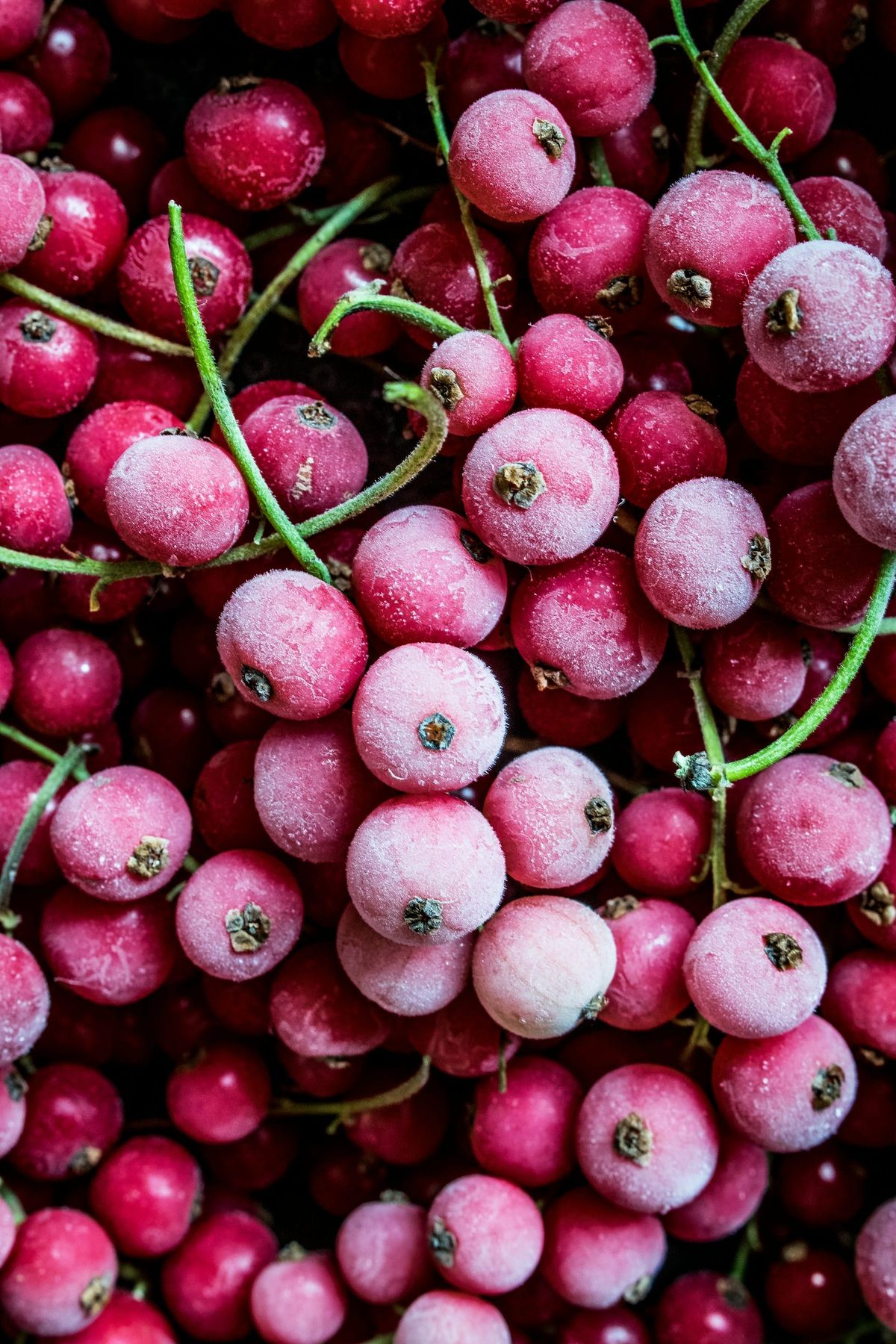
There is an incredible sense of agency in opening your freezer in the dead of winter and pulling out a bright, fragrant container of Summer. Whether it’s a batch of balcony-grown wild arugula spun into a bright lemon pesto, portioned containers of homemade chili ready to beat weeknight takeout, or deep-red summer berries harvested at their peak, food storage is empowerment. It is a quiet gift from your current self to your future self.
Freezing allows us to capture seasonal abundance, stretch our grocery budgets, build an accessible library of wholesome “fast food,” and honor the crops we grow or buy. But if you have ever defrosted a pint of strawberries only to be met with a sad, watery puddle, you know that home freezing comes with a catch: ice crystal physics.
To master the domestic deep-freeze, we need to look beneath the surface at cell structures, enzyme dynamics, and moisture control. Here is everything you need to know about the biological mechanics of freezing—and how to preserve Summer’s bounty like a food scientist.
The Science of the Big Chill
Why do some frozen foods thaw into lush, vibrant ingredients, while others turn to mush? It all comes down to ice crystals and cell walls.
The Ice Crystal Problem
Plant cells are largely made of water, held inside rigid cell walls strengthened by pectin—the structural carbohydrate that gives fresh produce its crisp snap.
When you freeze fruit at home, the cooling process happens relatively slowly compared to industrial flash-freezing. As the temperature drops, water molecules draw together to form crystalline ice lattices.
- Slow Freezing: During slow home freezing, water migrates outward from inside the cells, forming large, jagged ice crystals. As these crystals expand, they act like micro-daggers, piercing the delicate cell walls. When thawed, the ruptured cell structure can no longer hold water. The liquid drains out (a process known to food scientists as "syneresis" or drip loss), leaving behind a limp, mushy texture.
- Fast Freezing: Industrially flash-frozen produce passes through the "maximum ice crystal formation zone" (0°C to -5°C / 32°F to 23°F) in minutes. This rapid drop creates millions of microscopic ice crystals inside and outside the cell walls. Because the crystals remain tiny, they leave the structural walls intact. Upon thawing, the fruit retains significantly more of its original liquid and firmness.
SLOW FREEZING (Home)           FAST FREEZING (Industrial)
  ┌───────────────┐              ┌───────────────┐
  │   /\   /\     │              │  •  •  •  •   │
  │  /  \ /  \    │              │   •  •  •  •  │
  │  \  / \  /    │              │  •  •  •  •   │
  │   \/   \/     │              │   •  •  •  •  │
  └───────────────┘              └───────────────┘
Jagged,large ice crystals.       Micro-crystals; cell walls remain
pierce wall.                     intact upon thawing.
Simplified Rewrite: Pectin, Oxygen, and the Browning Enzyme
Why Do Sliced Peaches Turn Brown?
Have you ever wondered why an apple or peach turns brown shortly after you slice it? It all comes down to a natural chemical reaction inside the fruit.
Think of a whole fruit as a building full of locked rooms. The "glue" keeping the room walls strong is pectin—the exact same natural substance used to thicken jams and jellies.
Inside these rooms, the fruit stores special plant compounds. Outside in the hallway lives an enzyme called polyphenol oxidase (let’s call it PPO). As long as the cell walls stay intact, the enzyme and the compounds stay completely separate.
But when you bite, slice, or crush a fruit—or when large ice crystals puncture the cells during freezing—the walls crumble. PPO spills into the rooms, mixes with oxygen in the air, and triggers a chemical reaction that creates dark brown pigments.
In nature, this is a brilliant defense tactic! When a bug bites into a fruit, the browning turns the damaged area bitter and hard to digest, discouraging pests from eating more and sealing the wound against infection. In your kitchen, though, it just makes your fruit look unappealing and lose fresh flavor.
Preparation: Moisture, Oxygen, and the Tray Method
Moisture is the Enemy
Excess water on the surface of your produce is the primary catalyst for quality loss and freezer damage:
- Freezer Burn: When exposed to dry freezer air, ice on the surface of food undergoes sublimation—transitioning directly from solid ice to water vapor. This dehydrates the outer layers of the food, leaving tough, oxidized, discolored patches and stale flavors.
- Appliance Efficiency: Surface moisture evaporates into the freezer cabinet, condensing on cooling vents and sensors. Frost buildup acts as an insulator, forcing the compressor to run longer, raising energy costs, and risking temperature fluctuations that further degrade your stored food.
Always cool cooked fruits or stewed preserves completely in the refrigerator before transferring them to the freezer to prevent steam condensation inside the container.
The Flash-Freeze (Tray Method)
To prevent small fruits from fusing into a solid, unmanageable brick, freeze them individually first:
- Spread cleaned, thoroughly dried produce in a single layer on a parchment-lined baking sheet, ensuring no pieces touch.
- Freeze uncovered for 1 to 3 hours until solid.
- Immediately transfer the items into an airtight container or bag.
Pro-Tip: Do not leave uncovered trays in the freezer for more than 3 hours, or the produce will begin absorbing lingering freezer odors and drying out.
Summer Fruit Prep & Thaw Cheatsheet
| Fruit Category | Pre-Treatment Needed? | Best Preparation Method | Realistic Thaw Expectations |
Berries (Strawberries, Blueberries, Raspberries) | Blueberries/Strawberries: Wash & dry completely. Raspberries: Do not wash prior to freezing (they trap water and disintegrate). | Strawberries: Hull & halve. Blueberries/Raspberries: Freeze whole using the Tray Method. | High drip loss. Best used directly from frozen in smoothies, baked goods, cooked compotes, or oatmeal. |
Stone Fruits (Peaches, Plums, Cherries) | Blanching optional for skin removal. A toss in diluted lemon juice (ascorbic acid) reduces browning. | Pit, stem, and cut into wedges or slices. Tray freeze before bagging. | Texture softens significantly upon thawing. Excellent for fruit pies, cobblers, galettes, and cooked sauces. |
High-Water Melons (Watermelon, Cantaloupe) | No pre-cooking needed. Remove rind and seeds. | Cut into small 1-inch cubes. Tray freeze in a single layer. | Do not thaw for fresh eating. The extreme water content collapses cell structure entirely. Best blended frozen for sorbets, slushies, or cold drinks. |
Botanical Fruits (Figs, Tomatoes) | Wash and dry skin thoroughly. | Figs: Freeze whole or halved. Tomatoes: Freeze whole with skin on (skins slip off easily under warm water when thawed). | Figs become soft and custard-like (great for spreads or roasting). Tomatoes collapse into a rich base for cooked sauces and stews. |
Container Chemistry, Packaging, and Shelf Life
To stop oxidation and moisture loss, choosing the right vessel is vital.
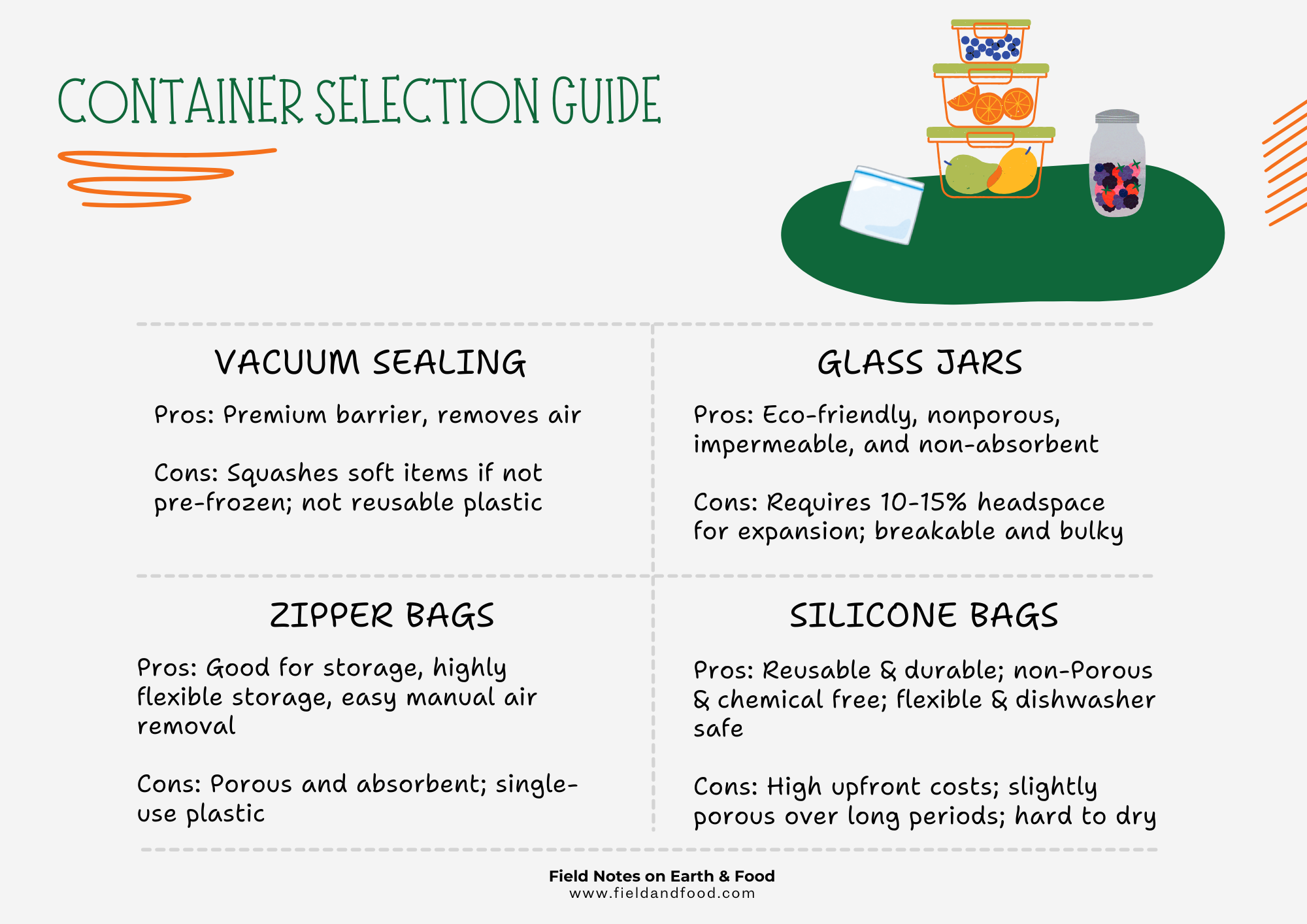
- Vacuum Sealers: The gold standard against freezer burn because they eliminate oxygen contact. However, soft items (like raspberries or ripe peach slices) should be pre-frozen solid before vacuum sealing to prevent crushing.
- Glass Jars: Highly sustainable and non-porous. However, because water expands by roughly 9% when freezing, always leave 1/2 to 1 inch (1.5–2.5 cm) of headspace at the top of the jar for liquids, purees, or cooked compotes to prevent the glass from shattering.
- Silicone Bags: Great reusable option for short-to-medium term storage. While slightly more gas-permeable than high-density plastics over long periods, squeezing out excess air ensures great results for 3–6 months.
- Beeswax Wraps: Avoid for freezing. Low temperatures render beeswax brittle, cracking the wax seal and allowing air to dehydrate the food underneath.
Shelf Life Guidelines
Freezing halts bacterial growth, making frozen food safe indefinitely at -18°C (0°F). However, quality gradually degrades due to slow enzymatic activity and fat oxidation:
- High-Fat Items (Pestos, Sauces with Butter/Oil): Peak quality for 2 to 4 months. (Fats undergo hydrolytic oxidation over time, developing rancid off-flavors).
- Low-Fat Cooked Fruit / Compotes / Applesauce: Peak quality for 8 to 12 months.
- Whole Raw Berries & Fruit Pieces: Peak quality for 6 to 10 months.
Thawing & Texture Realism
Freezing preserves vitamins and minerals far better than canning or high-heat processing, but it alters physical structure. Home-frozen fruit will lose its fresh bite—the crunch of a fresh fig or the taut pop of a ripe blueberry is permanently changed once cell walls rupture.
Managing culinary expectations allows us to use frozen fruit where it shines:
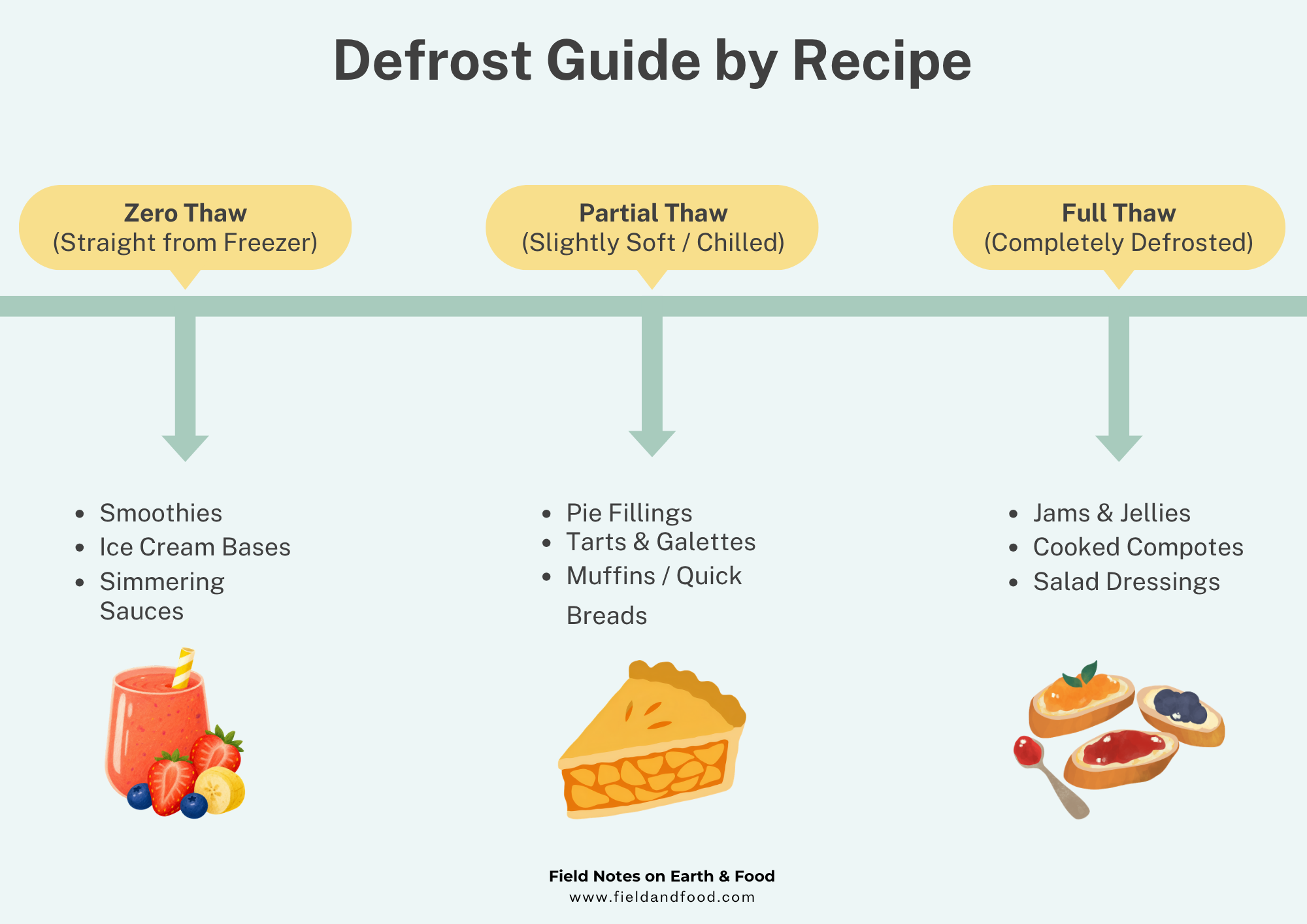
- Zero Thawing (Direct from Freezer): Toss frozen watermelon, berries, or stone fruit directly into high-speed blenders for smoothies, nice creams, or quick saucepan reductions.
- Partial Thawing (10–15 minutes on counter): Ideal for pie fillings, tarts, and muffins. Baking with partially thawed fruit prevents excess juices from turning pastry dough soggy, while ensuring even cooking times.
- Full Thawing (In the fridge overnight): Best when you plan to purée the fruit for sauces, cook it down into jams, or strain off natural juices to reduce into syrups.
Capturing Abundance
Preserving food isn't about competing with commercial supply chains; it’s about control, quality, and joy. Buying frozen produce at the supermarket can be expensive—especially for large households or avid berry lovers. Harvesting, prepping, and storing your own seasonal surpluses (like baking fallen orchard apples with cinnamon and freezing them without added sugar) transforms an overwhelming harvest into effortless, home-cooked convenience.
When winter arrives, your freezer becomes a pantry of pure potential—delivering fast, nourishing, homemade food at a moment's notice.
Happy Preserving!
Food storage isn't just about saving money or preventing food waste—it's about gifting yourself a little bite of Summer sunshine when the days get dreary.
Tackling your Summer harvest this week? What is the one Summer crop you can’t live without when Winter rolls around? Are you a berry hoarder, or do you have a secret freezer stash of stone fruit?
Let me know in the comments below—I’d love to hear what’s currently in your freezer library!