The Invisible Monastery Inside You: A Beginner’s Guide to the Human Microbiome
Digestion isn't just an input-output machine. Explore the invisible network of trillions of microbes living inside you, how they talk to your brain via the vagus nerve, and why feeding your internal "monks" holds the key to overall health.
We tend to view digestion as a straightforward input-output machine. Food goes in, gets broken down, and waste comes out. But what happens inside that mysterious middle step—the hidden "black box" of digestion—is anything but mechanical.
Have you ever felt a sudden flutter of butterflies in your stomach when seeing a crush? Or a heavy, sinking "gut feeling" when a situation feels wrong? What about those intense, sudden cravings for comfort food when life gets overwhelming?
These everyday experiences are not just random emotional reactions. They are real-time updates from a complex, invisible telephone conversation happening inside your body right now.
The Monks in Your Body
To picture your microbiome, imagine a network of tranquil monasteries located throughout your body—in your mouth, on your skin, in your lungs, and most densely, along the winding corridors of your intestines.
Living in these internal monasteries are trillions of microscopic "monks"—bacteria, fungi, viruses, and archaea. Like a dedicated monastic order, they live in a peaceful alliance with your body, working around the clock to maintain balance, shield their sanctuary (you) from invaders, and keep the peace.
Far from being passive passengers, these tiny inhabitants listen to every experience you have. The air you breathe, the emotions you process, the medicines you take, and the food you eat are all processed by your microbial community. When they get what they need, they thrive and keep you feeling vibrant. When they are starved or overwhelmed, they send out distress calls that ripple through your entire body.
Who Lives in the Gut?
Your body is home to a staggering population of microbes. According to research from the Weizmann Institute of Science, the average human body contains roughly 38 trillion bacterial cells—meaning your body contains about as many microbial cells as human cells.
While we often lump these tiny organisms together under the label "bacteria," your gut ecosystem is actually a diverse community comprising four major groups:
- Bacteria: The primary workforce. They ferment dietary fibers, produce vital vitamins, and train your immune system.
- Fungi: Minorities in number (often called the mycobiome), but essential for maintaining balanced microbial territories.
- Viruses: The managers of the microbial world (the virome). Most are phages—specialized viruses that infect and regulate bacterial populations to keep any single group from overpopulating.
- Archaea: Ancient, single-celled organisms that perform unique chemical jobs, such as removing excess hydrogen gas during digestion and converting it into methane.
The Three Essential Jobs of Your Microbial Community
Your internal monks don't just sit in quiet meditation; they run a complex biological economy. Here are three of their most critical daily duties:
1. Manufacturing SCFAs (Short-Chain Fatty Acids)
When you eat complex carbohydrates and fibers that your own digestive enzymes can't break down, your gut bacteria step in to ferment them. This fermentation process produces Short-Chain Fatty Acids (SCFAs)—primarily acetate, propionate, and butyrate.
Think of SCFAs as the official currency of gut health:
- Butyrate serves as the primary energy source for the cells lining your colon, helping them repair and renew.
- Acetate and Propionate travel through the bloodstream to the liver and peripheral tissues, helping to regulate cholesterol synthesis, appetite, and metabolic health.
2. Maintaining the Intestinal Barrier
Your intestinal lining is a micro-thin wall separating the contents of your digestive tract from the rest of your bloodstream. The cells of this barrier are held together by protein structures called tight junctions.
When your microbiome is healthy, its metabolic byproducts (especially butyrate) reinforce these tight junctions, creating a secure, selective filter. If the microbial community is starved or damaged, these junctions can loosen—a state often described as increased intestinal permeability (or "leaky gut"). This allows un-ingested food particles and bacterial fragments to leak into the bloodstream, triggering systemic immune responses and low-grade inflammation.
3. Nutrient Synthesis
Your microbes are active metabolic factories. They synthesize essential nutrients that your body cannot easily produce on its own, including Vitamin K (crucial for blood clotting) and several B vitamins (B12, folate, and riboflavin, which drive cellular energy).
The Gut-Brain Highway: How Your Microbiome Talks to Your Mind
How does an ecosystem in your belly influence your mood and thoughts? Through the Gut-Brain Axis, a multi-channel communication network anchored by the Vagus Nerve.
The vagus nerve is the longest cranial nerve in your body. It acts like a high-speed fiber-optic cable running directly from your brainstem down into your visceral organs, wrapping densely around your digestive tract.
This communication relies on different messaging channels:
- The High-Speed Vagus Line (Direct SMS): Fast, electrical signals sent directly between the enteric nervous system (the "brain in your gut") and your central nervous system.
- Hormones (Snail Mail & Telegrams): Chemical messengers released into the bloodstream that travel more slowly to target distant organs.
The Dopamine Connection
Dopamine is the brain’s primary chemical messenger for motivation, focus, and reward. While we often think of dopamine as a purely mental phenomenon, a significant portion of the body's dopamine and its precursors are synthesized right in the gastrointestinal tract.
When you eat nutrient-dense, plant-rich foods, your microbes produce chemical compounds that stimulate enteroendocrine cells in the gut lining to release dopamine. This signals to your brain: "This was good for us; let's do it again." Conversely, diets dominated by ultra-processed foods can hijack this system, driving intense cravings for quick-sugar rewards that offer zero long-term nourishment for your microbial monks.
What Is "Alpha-Diversity" (and Why Does It Matter)?
In ecology, alpha-diversity measures the variety and richness of different species living within a single specific environment.
Applied to your gut, high alpha-diversity means you host a vast, varied collection of different microbial species, rather than just a few dominant types.
Why is high alpha-diversity the hallmark of a resilient gut?
Imagine a city whose workforce consists entirely of plumbers. If a plumbing issue arises, the city thrives. But if the electrical grid goes down, the city collapses. A city with plumbers, electricians, carpenters, and engineers can withstand almost any crisis.
A diverse microbiome functions the exact same way. If one species of bacteria is temporarily depleted by illness or antibiotics, a diverse ecosystem has other species ready to step in and perform the same vital metabolic duties.

Nourishing the Ecosystem: What to Eat (and What to Avoid)
Keeping your microbial monks happy doesn't require complex diets, but it does require intentionality.
The Powerhouses: Plants & Ferments
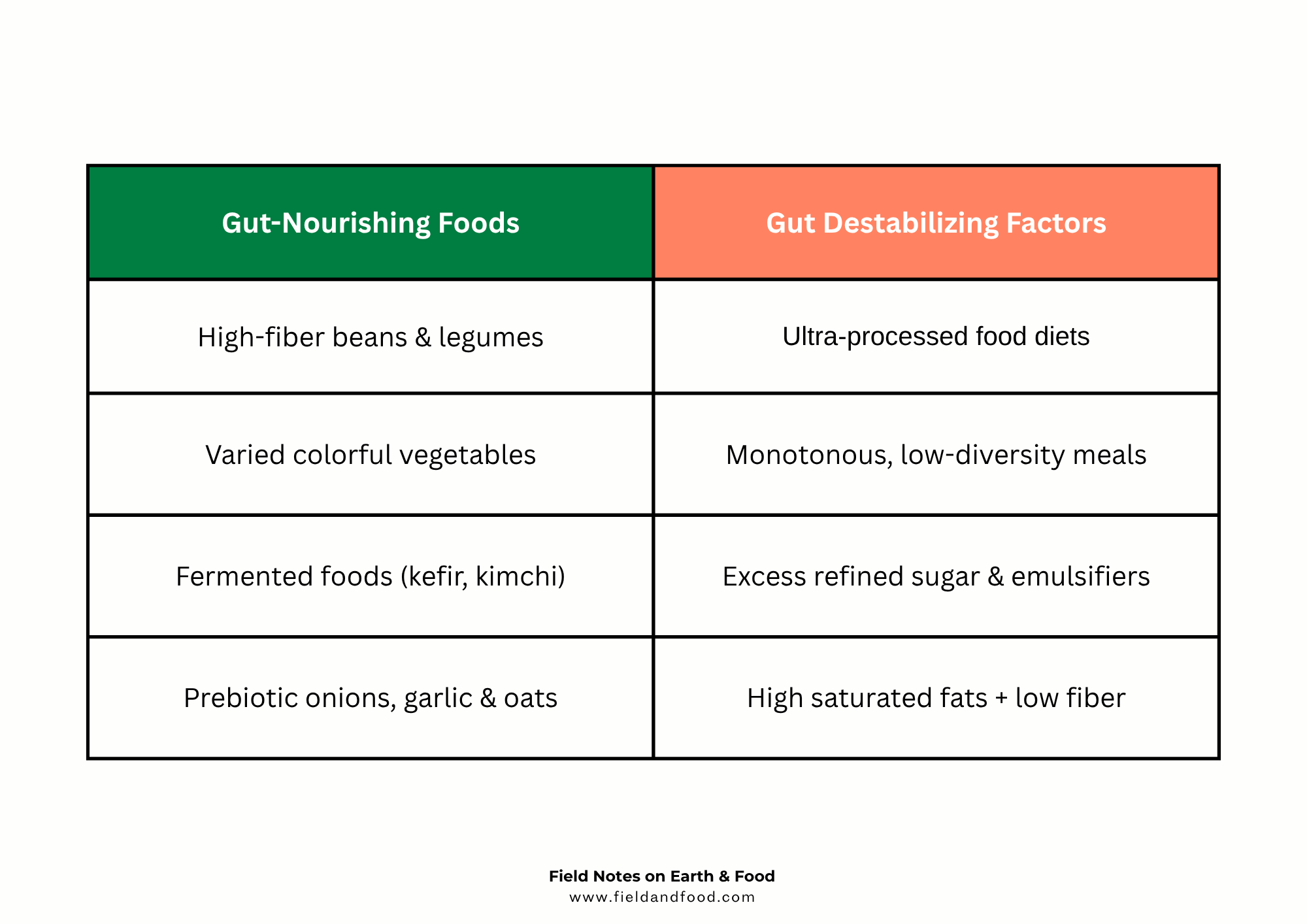
- Plant Diversity: The single most effective way to boost alpha-diversity is eating a wide variety of plants. Aiming for different vegetables, fruits, nuts, seeds, whole grains, and legumes each week provides different types of prebiotic fibers for different bacterial strains.
- Beans & Legumes: Beans are absolute powerhouses for the gut. They are loaded with resistant starches and soluble fibers that travel all the way to the colon intact, offering a feast for butyrate-producing bacteria.
- Fermented Foods: Live-culture foods like yogurt, kefir, sauerkraut, kimchi, and traditional pickles introduce beneficial live microorganisms and organic acids directly into your digestive tract.
What Destabilizes the Monks?
- Monotonous Diets: Eating the same few processed foods daily starves specialized bacteria, causing species to die off and drastically lowering your alpha-diversity.
- Ultra-Processed Foods: Diets high in refined sugars, excess sodium, and artificial or industrial emulsifiers—such as Polysorbate 80, carboxymethylcellulose (cellulose gum), mono- and diglycerides, and carrageenan—can degrade the protective mucus layer of the gut lining and promote the overgrowth of inflammatory bacterial strains.
While plant variety is vital, balance is key: your body still requires high-quality protein, healthy fats, and proper hydration to keep the entire human-microbe system running smoothly.
The Big Takeaway
Your body is not a single isolated organism—it is a shared sanctuary. The choices you make every day affect not just your own cells, but trillions of microscopic symbionts who work tirelessly to maintain your health.
While you cannot control every environmental exposure or stressful situation life throws your way, you can control what you invite into your internal ecosystem. By choosing diverse, whole foods, you nourish the invisible monks keeping watch inside you.
Coming up in Part 2 of our Microbiome series: What happens when peace is disrupted? We examine how acute and chronic stress alter your microbial community—sometimes in a matter of hours.